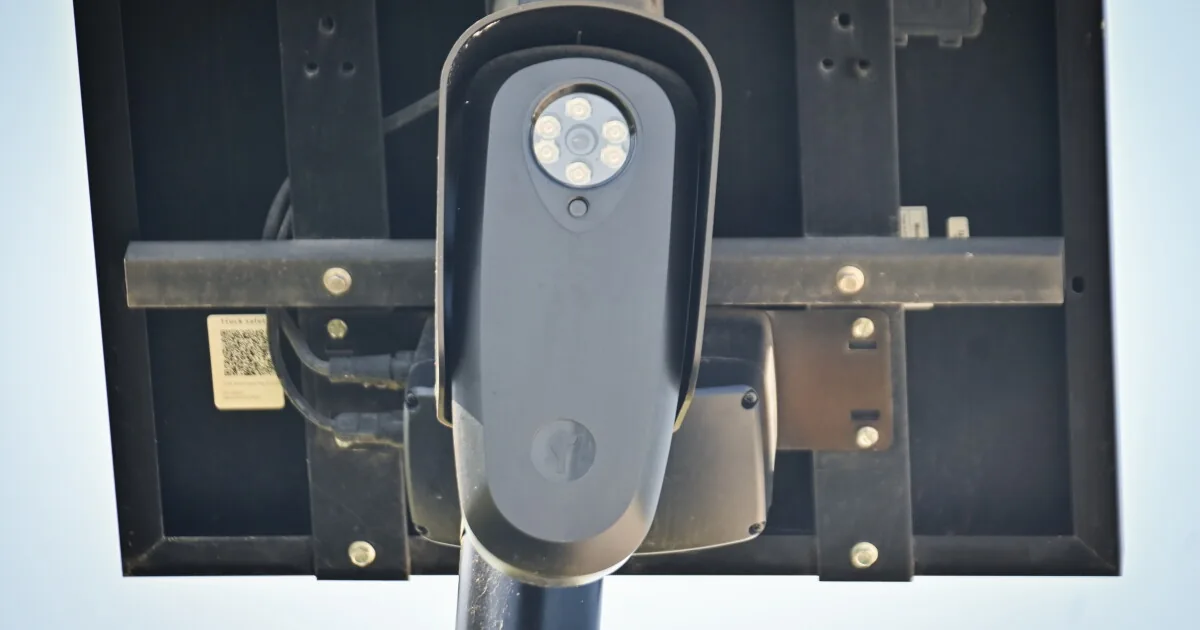
KANSAS CITY, MO — Flock cameras and other automated license plate readers are becoming a familiar part of the Kansas City area, and their rapid spread is now colliding with growing worries about privacy. A Department of Justice study says the cameras can capture as many as 2,000 license plates a minute, then make that information available to law enforcement agencies around the country.
That broad access is what has drawn attention to the system. KCUR reporter Sam Zeff said the key difference with Flock is that departments using it can join a large shared network, which makes it easy for police anywhere in the country to search the data from elsewhere.
Kansas City, Kansas, police records were searched almost 1.1 million times in one month
One local example shows just how heavily the system can be used. Between April 24 and June 24 this year, the Kansas City, Kansas, Police Department database was queried almost 1.1 million times.
The most frequent users were officers from the Houston Police Department. Dallas police came next, followed by the California Highway Patrol. Those numbers highlight how Flock data collected in one place can be pulled into investigations far beyond the city where the cameras are installed.
Police defend plate readers as a crime-fighting tool
Local police departments say automated license plate readers help prevent crime and improve investigations. The technology gives officers a way to check vehicle movements quickly, and supporters argue that can be useful when they are trying to track stolen cars, suspect vehicles, or patterns tied to criminal activity.
At the same time, the scale of the searches has made some residents uneasy. Critics are increasingly asking who can see the information, how often it is checked, and what limits exist on future use. The debate has become less about whether the cameras work and more about how much access should be allowed once the data is collected.
Public pressure is pushing some metro cities to leave Flock
Community pushback has already changed policy in parts of the Kansas City metro. Several cities, including Parkville and Weston, have ended their contracts with Flock after residents raised concerns about personal information and data sharing.
Those decisions show that local governments are beginning to respond to the privacy debate in different ways. For some cities, ending the contract was the simplest way to reduce access. For others, the question has become how to keep the cameras in place while setting clearer limits on who can use the data.
Lee’s Summit is writing new rules for outside agencies
Lee’s Summit Police Department is now drafting a memorandum of understanding that would require outside police departments to agree to certain data-protection standards before they can access Flock information. The move is meant to give the city more control over how its data is used.
That approach reflects a middle ground between keeping the system and shutting it down. Instead of ending use of the cameras, the department is looking at formal rules that would spell out expectations for privacy and access. The proposal suggests local officials are trying to balance investigative tools with public trust.
Missouri governor limits how long Flock data can be stored
State-level action has also entered the discussion. Missouri Gov. Mike Kehoe issued an executive order last week that limits how long Flock data can be stored.
The order adds another layer to a debate that is playing out across the region. Together, the city contract changes and the new storage limit show that public pressure is forcing agencies to define boundaries around automated plate-reader systems. The central question remains who can look at the data, for what purpose, and for how long it should remain available.